

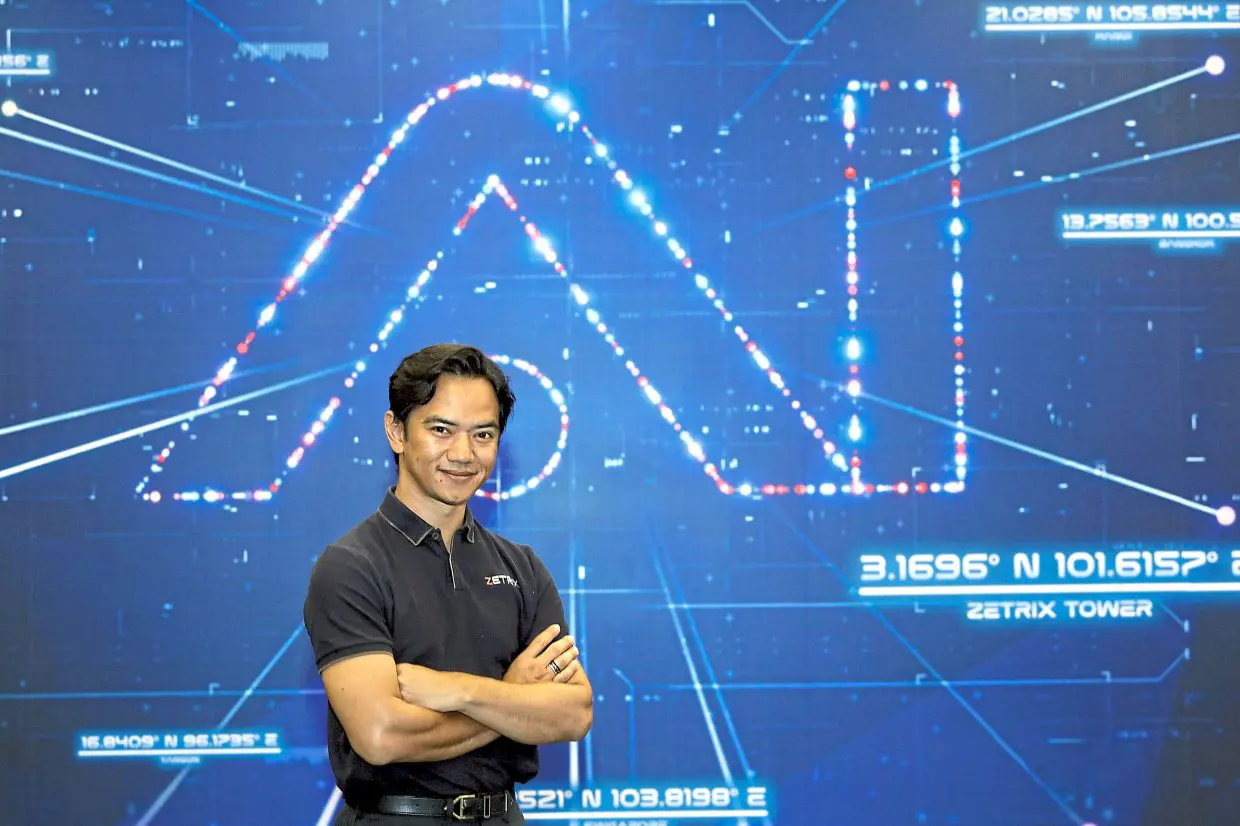
PETALING JAYA: With its own recent ambitious foray into the world of artificial intelligence (AI) and blockchain, Zetrix AI Bhd believes Malaysia is well-positioned to adopt and adapt to the fast-moving world of AI technology, and potentially reap economic benefits from the evolution.
Datuk Fadzli Shah Anuar, co-founder of Zetrix, the group's layer-1 blockchain platform, believes the country’s way forward lies not directly from its influx of its data centre (DC) pipeline, but more in how it enables its current workforce to improve productivity as the adoption of AI and high-level technology becomes more prevalent.
The issue is all the more relevant, given Malaysia’s seemingly continuous grapple with the issue of stagnating wages and increasingly higher cost of living.
In an exclusive interview, Fadzli acknowledged that while the government’s sanctioning of the DC influx represents its willingness to get on the tech bandwagon, the presence of DCs themselves will not translate into significant employment opportunities, especially given its highly skilled barrier of entry.
“In fact, while the adoption of AI and blockchain as a whole will mean jobs will be created, we see tasks will also be taken by non-humans, particularly a large portion of repetitive tasks that need to be done reliably and transparently,” he said.
Fadzli further explained why the group has forged several government-backed partnerships with Chinese entities, primarily focusing on AI innovation, blockchain interoperability, cross-border trade facilitation, digital identity and data trading.
With China being a significant economic and trade partner for Malaysia, he reiterated that Zetrix AI’s belief that much of China’s industrial and end-user behaviour will translate to some form of variant in this country, remarking: “Malaysia will follow similar growth and adoption cycles.”
Citing the recent trend of one-person companies or OPCs in China, with a single entrepreneur utilising multiple AI agents in delivering a service, Fadzli expects more tech-savvy youths adopting this business model.
He observed this as a form of job creation, commenting that Malaysia is well positioned to embrace this approach.
“This example will show that the current workforce can use AI and technology to become even more effective within its current roles, and perhaps we will see a tectonic shift of job roles.
“Businesses will move dynamically, a simple but huge departure from how things were previously, and we see Malaysia adopting such technology addictively,” he noted.
Nevertheless, Fadzli recognised the trust challenges that come with widespread AI and tech adoption, especially in maintaining service dependency and data privacy trust.
He believes there are three facets to building digital trust, namely, the reliability of the service rendered, data protection and the assurance that there will be no leakage of information, and the certainty that the parties dealing with each other know exactly who they are transacting with.
“We see that with the use of AI agents, not only can everything be done very accurately but also securely, because it will all be based on data packets. So for that, we believe that over the long term (AI), the agent-to-agent economy will be a commonplace occurrence,” said Fadzli.
As to how reality plays out this adoption, he is betting that it will change the way the public consume everyday services, from booking a car, ordering products online to even eCommerce, with AI agents securely matching orders to personal profiles.
Furthermore, he feels as applications become simpler for higher utilisation among the public, due to faster iteration cycles, there also needs to be user acceptance and awareness, and the necessity to marry digital identities (such as Malaysia’s MyDigital ID) with ever-growing technologies to ensure better data privacy and prevent scams.
With China and Asean being economies with somewhat different profiles, Fadzli conceded that there is no straightforward answer to this question.
He emphasised that China, due to the sheer size of its population and economy, can set standards, but it does not represent cluster economies which are interdependent as a trading bloc such as Asean.
“In our view, Asean is opportunistically a good showcase of how independent countries can work together and we are in a position to adopt certain standards that could be carried through an entire bloc, which can then be mirrored by the Gulf Cooperation Council or South American nations,” he explained.
On the differences between China and Asean notwithstanding, Fadzli believes that certain major economies (such as China or the United States) will lead in certain standards and cluster nation groups will then adopt these standards.
He says Asean state leaderships believe in digitalisation as a serious economic lever, as there is concerted effort to take this conversation seriously.
“Governance, however, is not keeping pace with the adoption or the onboarding of technology.
“What we can do to add value to what China is doing, using QR codes as an example, is to enable cross-border transactions and tech adoption more efficiently. Can governance keep up with such innovation?”
In addition, Fadzli said a more widespread usage of stablecoins such as the JMYR, a Malaysian ringgit-pegged stablecoin, would mean trades can be analysed with data more efficiently, while financing and remittances can be made instant.
JMYR is a fully backed, 1:1 digital token representing the Malaysian ringgit, designed for fast, programmable payments, settlements, remittances, and on/off-ramp functionality on Zetrix’s blockchain.
“It is essential to construct a stablecoin infrastructure, as this can create a transparent yet secure, efficient and competitive marketplace,” said Fadzli.

