American troops are reportedly told that the conflict in Iran is aimed at paving the way for the end times and Armageddon. The belief is that Trump “has been anointed by Jesus to light the signal fire in Iran to trigger Armageddon and mark His return to Earth”.
In a recent Pentagon news briefing, Hegseth reportedly stated: “Crazy regimes like Iran, hell-bent on [religious] delusions, cannot have nuclear weapons.” Religion is also employed to justify America’s support for Israel.
Mike Huckabee, American ambassador to Israel, reportedly told prominent commentator Tucker Carlson that it would be “fine” if Israel took “essentially the entire Middle East” because it was promised the land in the Bible. Meanwhile, Israeli Prime Minister Benjamin Netanyahu compared Iran to the Amalekites, seen in Jewish tradition as representing evil.
US President Donald Trump has claimed he could ‘take out Iran in one night’ and has reiterated his threat to bomb the country ‘back to the Stone Ages.’ Photo: AFP
It is extremely dangerous to rationalise an imperialist war of aggression through religious and civilisational rhetoric. Trump’s actions have pushed the region closer to a wider conflagration and have also impacted the global economy. His latest statements have raised fears of further escalation.
The calculated assassinations of senior Iranian political and military leaders have created a serious leadership vacuum, likely to be filled by more radical elements, making any efforts at mediation extremely difficult.
While America and Israel can decimate Iran’s civil and military infrastructure, they cannot force it to capitulate. Iran has hardened its position, given the relentless destruction of its land, complicating any attempts at de-escalation. Trump’s threats of escalation have worsened the situation. We will have to wait and see what he does next.
This article was first published in The Dawn, an ANN partner of The Daily Star, on April 8, 2026.
Zahid Hussain is a Pakistani journalist and author. His Twitter handle is @hidhussain
Smoke billows in the distance from an oil refinery following an Israeli strike on the Iranian capital Tehran. (Photo by ATTA KENARE / AFP)
WASHINGTON/DUBAI/JERUSALEM: President Donald Trump called on Tuesday for Iran's unconditional surrender and warned US patience was wearing thin, but said there was no intention to kill Iran's leader "for now", as the Israel-Iran air war raged for a fifth day.
Explosions were reported in Tehran and the city of Isfahan in central Iran, while Israel said Iran fired more missiles late on Tuesday and early Wednesday. Air raid sirens sounded in southern and central Israel, and explosions were heard over Tel Aviv. The Israeli military said it had conducted strikes on 12 missile launch sites and storage facilities in Tehran.
Trump's comments, delivered via social media, suggested a more aggressive stance toward Iran as he weighs whether to deepen US involvement.
"We know exactly where the so-called 'Supreme Leader' is hiding," he wrote on Truth Social. "We are not going to take him out (kill!), at least not for now... Our patience is wearing thin."
Three minutes later, he posted, "UNCONDITIONAL SURRENDER!"
Israeli Defence Minister Israel Katz said Iran's Supreme Leader Ayatollah Ali Khamenei could face the same fate as Iraqi President Saddam Hussein, who was toppled in a US-led invasion and hanged in 2006 after a trial.
"I warn the Iranian dictator against continuing to commit war crimes and fire missiles at Israeli citizens," Katz told top Israeli military officials.
Trump's sometimes contradictory and cryptic messaging about the conflict between close US ally Israel and longtime foe Iran has deepened the uncertainty surrounding the crisis. His public comments have ranged from military threats to diplomatic overtures — not uncommon for a president known for an often erratic approach to foreign policy.
Trump said on Monday that he might send US Middle East Envoy Steve Witkoff or Vice President JD Vance to meet Iranian officials. The president said his early departure from the Group of Seven nations summit in Canada had "nothing to do" with working on a ceasefire deal, and that something "much bigger" was expected.
Britain's leader Keir Starmer said there was no indication the US was about to enter the conflict.
Trump met for 90 minutes with his National Security Council on Tuesday afternoon to discuss the conflict, a White House official said. Details were not immediately available.
The US is deploying more fighter aircraft to the Middle East and extending the deployment of other warplanes, three US officials told Reuters. The move follows other deployments that US Defence Secretary Pete Hegseth described as defensive in nature. The US has so far only taken defensive actions in the current conflict with Iran, including helping to shoot down missiles fired toward Israel.
Women react as they check the destruction in the northern Arab-Israeli city of Tamra. (Photo by AHMAD GHARABLI / AFP)
Regional Influence Weakens
Khamenei's main military and security advisers have been killed by Israeli strikes, hollowing out his inner circle and raising the risk of strategic errors, according to five people familiar with his decision-making process.
The Israeli military said on Tuesday it had killed Iran's wartime chief of staff Ali Shadmani, four days after he replaced another top commander killed in the strikes.
With Iranian leaders suffering their most dangerous security breach since the 1979 Islamic Revolution, the country's cybersecurity command banned officials from using communications devices and mobile phones, Fars news agency reported.
Israel launched a "massive cyber war" against Iran's digital infrastructure, Iranian media reported.
Ever since Iran-backed Hamas attacked Israel on Oct 7, 2023, and triggered the Gaza war, Khamenei's regional influence has waned as Israel has pounded Iran's proxies — from Hamas in Gaza to Hizbollah in Lebanon, the Houthis in Yemen and militias in Iraq. Iran's close ally, Syria's autocratic president Bashar al-Assad, has been ousted.
Israel launched its air war — its largest ever on Iran — on Friday after saying it had concluded the Islamic Republic was on the verge of developing a nuclear weapon.
Iran denies seeking nuclear weapons and has pointed to its right to nuclear technology for peaceful purposes, including enrichment, as a party to the international Non-Proliferation Treaty.
Israel, which is not a party to the NPT, is the only country in the Middle East believed to have nuclear weapons. Israel does not deny or confirm that.
Israeli Prime Minister Benjamin Netanyahu has stressed that he will not back down until Iran's nuclear development is disabled, while Trump says the Israeli assault could end if Iran agrees to strict curbs on enrichment.
Before Israel's attack began, the 35-nation board of governors of the UN nuclear watchdog, the International Atomic Energy Agency, declared Iran in breach of its non-proliferation obligations for the first time in almost 20 years.
The IAEA said on Tuesday an Israeli strike directly hit the underground enrichment halls at the Natanz facility.
The Iranian news website Eghtesadonline, which covers economic news, reported on Tuesday that Iran arrested a foreigner for filming "sensitive" areas at the Bushehr nuclear power plant for Israel's spy agency Mossad.
People take cover inside a cable car tunnel following a missile attack from Iran on Israel, at Haifa, Israel June 17, 2025. REUTERS/Itay Cohen
Iranian security forces also arrested a "terrorist team" linked to Israel with explosives in a town southwest of the capital Tehran, Iranian state media reported.
Oil Markets on Alert
Israel says it now has control of Iranian airspace and intends to escalate the campaign in coming days.
But Israel will struggle to deal a knock-out blow to deeply buried nuclear sites like Fordow, which is dug beneath a mountain, without the US joining the attack. Israel's Katz said Fordow was an issue that will be addressed.
Iran has so far fired nearly 400 ballistic missiles and hundreds of drones towards Israel, with about 35 missiles penetrating Israel's defensive shield, Israeli officials say.
Iran's Revolutionary Guards said they hit Israel's Military Intelligence Directorate and the foreign intelligence service Mossad's operational centre early on Tuesday. There was no Israeli confirmation.
Iranian officials have reported 224 deaths, mostly civilians, while Israel said 24 civilians had been killed. Residents of both countries have been evacuated or fled.
Global oil markets are on high alert following strikes on sites including the world's biggest gas field, South Pars, shared by Iran and Qatar.
As a country with special influence over Israel, the US should particularly adopt an objective and impartial stance, take due responsibility, and play a positive and constructive role in de-escalating tensions and preventing the conflict from further expanding.
Anwar conveys interest to Brazilian president and ‘will go through the process’
BUKIT MERTAJAM: Malaysia will seek to join the BRICS (Brazil, Russia, India, China and South Africa) intergovernmental organisation, says Datuk Seri Anwar Ibrahim.
The Prime Minister said he had conveyed Malaysia’s wishes to Brazil’s President Luiz Inacio Lula da Silva.
“We (Malaysia) will go through the process to enable the country to join the organisation. For the past two months, the Foreign Ministry has conducted a study on our policy before deciding to join BRICS.
“I have spoken to the President of Brazil about our wish,” he said after attending a gathering for local residents in Mengkuang Semarah here yesterday.
Anwar was earlier quoted as saying that Malaysia would begin the formal procedures to join BRICS.
In an interview with Shanghai-based news site Guancha, Anwar said Malaysia was now awaiting the final decision and feedback from the South African government.
On the ground: Anwar getting friendly with the children who attended the qurban ceremony with the Prime Minister at Masjid Jamek Cerok Tokun Bawah in Bukit Mertajam, Penang. — Bernama
BRICS was originally founded as BRIC, with the four original members being Brazil, Russia, India and China. It held its first summit in Yekaterinburg, Russia, in 2009.It was renamed BRICS when South Africa joined in 2010.
The group now comprises Brazil, Russia, India, China, South Africa, Iran, Egypt, Ethiopia, the United Arab Emirates and Saudi Arabia.
Together, they make up about 30% of the world’s land surface and 45% of the global population.
The grouping, originally set up to highlight investment opportunities, has evolved into a geopolitical bloc where members meet annually at formal summits.
In July 2014, BRICS created a US$100bil (RM471bil) New Development Bank with a currency pool worth over another US$100bil.
Since 2012, it has been planning an optical fibre submarine communications cable system, known as the BRICS Cable.
During the summit in 2023, BRICS members committed to studying the feasibility of a new common currency.
To date, 15 summits have been held with Russia scheduled to hold the next one in Kazan, Russia, in October.
WASHINGTON (Reuters) - The United States believes there have been potentially multiple attacks on locations in Iraq, including the al Asad airbase that hosts U.S. forces, a U.S. official told Reuters on Tuesday, without providing additional information.
It was unclear what other sites may have been attacked. Tensions have mounted with Iran following a U.S. drone strike on Friday that killed Iranian military commander Qassem Soleimani.
Another U.S. official, speaking on condition of anonymity, had confirmed to Reuters earlier that a rocket attack had taken place against al Asad airbase, but did not confirm other sites.
U.S. President Donald Trump visited the base in his December 2018 trip to Iraq.
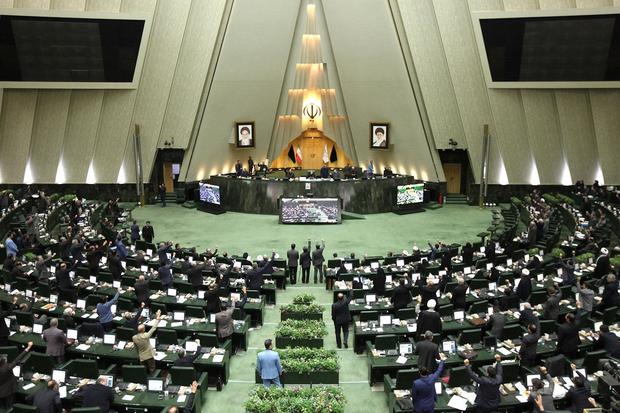
The Iranian parliament approved bill on Tuesday that designates United States military forces as terrorists, days after American airstrikes killed top Iranian military leader General Qassem Soleimani in Iraq. The bill is similar to the action the U.S. took last year when the Trump administration designated Iran's Islamic Revolutionary Guard Corps (IRGC) as a foreign terrorist organization.
Members of parliament passed the bill declaring the U.S. military and the Pentagon terrorist entities, according to Iranian state media. Under the bill, the Iranian government will also provide $220 million to the IRGC to "reinforce its defense power in vengeance for General Soleimani's assassination," the news agency reported, as tensions between the U.S. and Iran rise.
Iranian parliament voted to designated the U.S. military and the Pentagon terrorist organizations
This handout picture shows Iranian lawmakers raising their hands to vote during a parliamentary session in Tehran. Iran's parliament passed a bill designating all U.S. forces "terrorists" over the killing of a top Iranian military commander in an airstrike last week. Icana News Agency
A senior U.S. official told CBS News national security correspondent David Martin that Iran's Supreme Leader Ayatollah Ali Khamenei has ordered a direct attack on American interests in retaliation for the airstrike that killed Soleimani, his top military commander and friend. The official said the U.S. military was "extremely concerned" that the retaliation could come quickly.
When asked by CBS News correspondent Elizabeth Palmer on Tuesday when the Iranian response would come, Iran's Foreign Minister Mohammad Javad Zarif would only say that his country would retaliate at the time of its choosing. While a senior Iranian commander threatened at Soleimani's funeral to "set ablaze" America's supporters in the region, Zarif told CBS News the response would be "proportionate" and "against legitimate targets."
Secretary of State Mike Pompeo continued leading the Trump administration's defense of the targeted missile strike that killed Soleimani. He insisted that
President Trump was right to order the killing and dismissed Iran's claim that Soleimani was in Iraq for diplomatic purposes.
In April, the U.S. declared the Revolutionary Guard Corps as a foreign terrorist organization, which makes it illegal for anyone to provide material support to the
group. The U.S. Defense Department used the Guard's designation to support the strike last week that killed Soleimani, the head of Iran's elite Quds military force and one of the most powerful figures in the Islamic Republic
Iran's Islamic Revolution Guard Corps (IRGC) on Wednesday
targeted U.S. bases in Iraq including al-Asad and Harir Camp to the
north of Erbil with a second wave of surface-to-surface missiles,
semi-official Fars news agency reported
What is happening to Iran is another version of the
“America First” policy. But this is a globalized world. How can the US
not be affected when the Middle East is in a bad condition?
Will it be good for the US if a large-scale Iran war breaks out? If
Washington does not want that, why create uncertainty? Is it responsible
to take the bet?
Global financial markets are facing a stark wake-up call that they need to unite to stand against acts of what can only be described as economic terrorism by a country which unilaterally imposes its will on others and pursues its own goals at the cost of the interests of others.
More than a year after US President Donald Trump fired the first tariff salvo at China, he is extending the battlefield around the world. On Friday, his administration announced that it will end special trade treatment for India, removing a status that exempts billions of dollars of the South Asian country's products from US tariffs. Trump is seriously mulling slapping tariffs on Mexican imports as he believes the country has taken advantage of the US for decades.
Even close allies cannot trust they will be exempt from Trump's tariff addiction. It was reported that the administration considered imposing tariffs on imports from Australia, but eventually decided against the move amid opposition from his aides, "at least temporarily."
Obviously, Trump, a businessman-turned president, is aiming his trigger finger regardless of the targets, be they US competitors or allies. Trump grumbles about his country subsidizing the world and weakening US industry and pledges to make America great again. But he doesn't realize that a great superpower is supposed to provide public goods rather than resorting to coercion for selfish gains. His tactics are nothing short of economic terrorism.
The International Air Transport Association has estimated that the US-China trade war and high fuel prices will wipe $7.5 billion off expected airline profits in 2019. This is just the figure from the airline industry, which is enough to show the disastrous impact the US-initiated economic terrorism has on the globe. Trump may disrupt the global supply chain with the US' economic clout, but how can a disrupted global supply chain serve the US' strategic objectives of being a great country?
What is worse, before the US becomes great again as the president wishes, he is actually employing the strategy of blocking other countries to take the lead, as we see in his actions in quashing Huawei's 5G advancement.
Later this month, leaders from the world's top economies will meet at the G20 summit in Osaka, Japan to discuss key economic issues that plague the world. The conventional views of globalization and its benefits are still shared by most countries, and many countries and regions are continuing to open their economies. They should unite to face the chaos created by the Trump administration and find a way forward, so the process of globalization will not be held hostage by the US' economic terrorism. - By Zhang Yi
As a civilization that is thousands of years old, China has
always been integrating into the current international system and
taking responsibility to defend the international order after the world
wars and the international rule of law coming into force. At the same
time, China is dedicated to promoting democratization and legalization
of international relations.
Mr
Ren Zhengfei survived Mao Zedong's great famine and went on to build a
telecom giant with US$92 billion in revenue that strikes fear among some
policymakers in the West.PHOTO: EPA-EFE
HONG KONG (BLOOMBERG) - At the sprawling Huawei Technologies campus in Shenzhen, the foodcourt's walls are emblazoned with quotes from the company's billionaire founder and chief executive Ren Zhengfei.
Then there's the research lab that resembles the White House in Washington. Perhaps the most curious thing, though, are three black swans paddling around a lake.
For Mr Ren, a former People's Liberation Army soldier turned telecom tycoon, the elegant birds are meant as a reminder to avoid complacency and prepare for unexpected crisis. That pretty much sums up the state of affairs at Huawei, whose chief financial officer, Ms Meng Wanzhou, who's also Mr Ren's daughter, is in custody in Canada and faces extradition to the United States on charges of conspiracy to defraud banks and violate sanctions on Iran.
The arrest places Huawei in the cross-hairs of an escalating technology rivalry between China and the US, which views the company, a critical global supplier of mobile network equipment, as a potential national security risk.
Hardliners in President Donald Trump's administration are especially keen to prevent Huawei from supplying wireless carriers as they upgrade to 5G, a next-generation technology expected to accelerate the shift to Internet-connected devices and self-driving cars.
Mr Ren is a legendary figure in the Chinese business world. He survived Mao Zedong's great famine and went on to build a telecom giant with US$92 billion (S$126 billion) in revenue that strikes fear among some policymakers in the West. Huawei is the No. 1 smartphone maker in China, and this year eclipsed Apple to become second maker globally, according to research firm IDC.
Though it has a low profile compared with China's Internet giants, Huawei's revenue last year was more than Alibaba Group Holding, Tencent Holdings and and Baidu Inc combined. About half of its revenue now comes from abroad, led by Europe, the Middle East and Africa.
The company's high-speed global expansion has come under fire for years, starting with the Committee on Foreign Investment in the US' derailing of an acquisition in 2008. More recently, Australia, New Zealand and the US have blocked or limited the use of Huawei gear.
The arrest and prosecution of Ms Meng in US courts comes amid a far bigger US-China struggle for technology dominance in the decades ahead - and could have huge, and potentially severe, consequences for Huawei. Mr Ren declined an interview request from Bloomberg News.
"It gives Trump a bargaining chip," said Mr George Magnus, an economist at Oxford University's China Centre. "She's the daughter of the CEO, Ren Zhengfei, himself a former PLA officer, and Huawei's alleged dealings with Iran are just the latest in a string of concerns."
An outright ban on buying American technology and components, should it come to that, would deal Huawei a crushing blow. Earlier this year, the Trump administration imposed just such a penalty on ZTE Corp, also a Chinese telecom, and threatened its very survival before backing down.
Both Huawei and ZTE are banned from most US government procurement work.
A full-blown, commercial ban in the US would not only apply to hardware components, but also cut off access to the software and patents of US companies, Mr Edison Lee and Mr Timothy Chau, analysts with Jefferies Securities, wrote in a report.
"If Huawei cannot license Android from Google, or Qualcomm's patents in 4G and 5G radio access technology, it will not be able to build smartphones or 4G/5G base stations," they note.
The company's legal troubles in the US may also spill into other markets.
"Government telecommunication infrastructure requirements are essentially locking out the Chinese supplier in critical growth markets," noted Morningstar Research equity analyst Mark Cash in an e-mail. "Additionally, telecom providers without government imposed restrictions may start limiting their usage of Huawei equipment for their 5G network build-outs."
If there's a Darth Vader in the minds of Chinese national security hawks in Washington worried about China's rising tech power, it's Mr Ren. In China, though, he's feted as a national hero, who rose from humble beginnings to the pinnacle of wealth and status in Chinese society.
His grandfather was a master of curing ham in his village in Zhejiang province, which afforded Mr Ren's father the chance to become the village's first university student, according to a 2001 essay by Mr Ren about his upbringing, which was published on a website linked to the Chinese Academy of Social Sciences.
His father, Mr Ren Moxun, was a Communist Youth League member, who later worked as a teacher and an accountant at a military factory, but who kept up his rebel fervour under the Kuomintang by selling revolutionary books.
After moving to rural Guizhou province, he met his wife Cheng Yuanzhao and gave birth to Mr Ren Zhengfei, the oldest of two sons and five daughters.
The family lived on modest teaching salaries. In one of Mr Ren's speeches, he remembered how his mother read him the story of Hercules, but withheld the ending until he came home with a good report card.
Famine Years
During the Great Leap Forward campaign that started in the late 1950s, a famine came to his home town after Communist Party industrialisation and collectivisation policies went off the rails. Mr Ren recalled in his essay how his mother stuffed into his hand each morning a piece of corn pancake while asking about his homework. His good grades gained him entry to the Chongqing Institute of Civil Engineering and Architecture.
After graduation, he worked in the civil engineering industry until 1974, when he joined the PLA's Engineering Corps as a soldier, and worked on a chemical fibre base in Liaoyang. Huawei says he rose to become deputy director, but did not hold military rank. He does, however, often pepper his speeches with military references.
"Our managers and experts need to act like generals, carefully examining maps and meticulously studying problems," Mr Ren said in a speech posted on a website for Huawei employees.
Mr Ren's Communist Party credentials aren't as deep as his father's. He attended the 12th National Congress of the Communist Party in 1982, and once cited the party's dogma of "a struggle that never ends" when defending the company's tough work hours.
But Mr Ren was a bookworm as a child and was denied acceptance into the Communist Youth League, according to the book Huawei: Leadership, Culture And Connectivity, a book co-authored by David De Cremer, Tian Tao and Wu Chunbo.
He didn't become a Communist Party member in the PLA until late in his military career. However, a 2012 House permanent Select Committee on Intelligence report on Huawei asked why a private company had a Communist Party Committee, which has become common among China's Internet giants.
Mr Ren retired from the army in 1983, and joined his first wife to work at a Shenzhen company involved in the city's special economic zone. It was around then that he had to sell off everything to pay a debt related to a business partner, and lost his job at Shenzhen Nanyou Group, as well as his first marriage, according to Ren Zhengfei And Huawei by author Li Hongwen.
Comeback Play
After a period of sleepless nights while living with family members, Mr Ren saw an opportunity. When China began its economic opening under Deng Xiaoping, the telephone penetration rate was lower than the average rate in Africa, or 120th in the world. He founded Huawei with four partners in 1987 with 21,000 yuan in initial working capital, just above the minimum threshold required under Shenzhen rules.
Huawei started out as a trader of telecom equipment, but the company's technicians studied up on switchboards and were soon making their own. Workers put in long hours in Shenzhen's swampy heat with only ceiling fans. Mr Ren kept up morale with subtle gestures, like offering pigtail soup to workers putting in overtime.
The company became known for its "mattress culture" in which workers would pass out on office mattresses from exhaustion. In 2006, a 25-year-old worker Hu Xinyu, who had made a habit of working into the wee hours and then sleeping at the office, died of viral encephalitis. Some Huawei employees subsequently committed suicide.
The deaths triggered a revision of the company policy on overtime, and the creation of a chief health and safety officer role.
It wasn't the only move Mr Ren made to stabilise morale. He used to pay his workers only half their salaries on payday, but eventually decided to convert the other half of employee salaries and bonuses into shares. The company's 2017 report shows that he has a 1.4 per cent stake, giving him a net worth of US$2 billion.
Wolf Culture
Huawei struggled for market share, with foreign companies using so-called "wolf culture" of aggressive salesmanship, which sometimes materialised in the form of Huawei employees flooding sales events with several times more salespeople than competitors.
The company ventured into international markets in the 2000s, with telecom equipment that was more affordable than products of competitors such as Cisco Systems. Huawei later admitted to copying a small portion of router code from Cisco and agreed to remove the tainted code in a settlement.
Mr Ren since stepped up the company's research and development. Of its 180,000 employees, about 80,000 are now involved in R&D, according to the company's 2017 report, and the company has been known to recruit some of China's top talent out of universities.
The company recently refocused on existing markets after the US government called Huawei a national security threat, and cited concerns over its possible control of 5G technologies. Mr Trump signed a Bill banning government use of Chinese tech including Huawei's, and has even contacted allies to get them to avoid using Huawei equipment.
Collectively owned by its employees, the company is known for a culture of discipline, in which no one, Mr Ren included, has their own driver or flies first class on the company dime. Lately, Mr Ren has been warning employees against using fake numbers or profit to enhance performance. The company set up a data verification team in 2014 within the finance department, which was overseen by Mr Ren's daughter.
In a recent speech posted on the Huawei employee network, however, he called for patience with critics, but rejected foreign intervention. "We will never give in or yield to pressure from outside," he said.
That maxim is going to be soon put to the test by the US Department of Justice.
Meng Wanzhou, the chief financial officer of Chinese tech
giant Huawei, who was granted a $7.5 million bail, is unlikely to be
extradited to the US because she is charged for political reasons,
analysts said.